Most photographers start out invoicing on WhatsApp: a message with the amount, a UPI ID, and a screenshot when it's paid. That works until a corporate client asks for a GST invoice, or your turnover crosses the registration limit.
This guide covers the basics: when you need to register, what a GST invoice must show, and how to handle advances and part-payments. It's general information, not tax advice, so confirm the details for your situation with a chartered accountant.
Key takeaways
- Registration is generally compulsory above ₹20 lakh turnover for services, and lower in some states.
- Photography is generally taxed at 18%, under SAC heading 9983.
- Every invoice needs your GSTIN, a consecutive number, the place of supply and the tax split.
- Record advances properly, and ask your CA how to treat them.
- Confirm codes and rates with a chartered accountant.
Do you need GST registration?
For most service providers, GST registration becomes compulsory once aggregate turnover in a financial year crosses ₹20 lakh. The limit is lower in some special category states, so check the figure for your state.
You can also register voluntarily below the limit. Many photographers do, because companies, agencies and event organisers often prefer suppliers with a GSTIN, since it lets them claim input tax credit.
Registering has a cost too: you'll file regular returns and charge GST on your invoices. If most of your clients are couples rather than businesses, talk to your CA about whether registering early makes sense.
GST rate and SAC code for photography
Photography services are generally taxed at 18% GST. Services are classified with SAC codes, and photography falls under heading 9983. Event photography and videography, for example, is commonly listed as 998383.
Sources don't always agree on the exact sub-code for every type of shoot, so confirm the right SAC code for your work with your CA and use it consistently on every invoice.
If a client is in another state, the tax is usually IGST instead of CGST plus SGST. Your invoice needs the place of supply so the right tax is charged.
What a GST invoice must show
Rule 46 of the CGST Rules sets out what a tax invoice must contain. In practice, a photographer's invoice should include the following. Check the current rules or ask your CA for the complete list.
- Your name, address and GSTIN
- A unique, consecutive invoice number and the date
- The client's name and address, and their GSTIN if they're registered
- The place of supply, with the state name and code for inter-state work
- A description of the service and the SAC code
- The taxable value, the GST rate and the tax amount, split into CGST and SGST, or IGST
- The total amount payable
- Your signature or digital signature
Handling advances and part-payments
Wedding work is usually paid in stages: a booking advance, a payment on the wedding day and a balance on delivery. Each stage needs a clear record, or you'll spend the album season matching UPI screenshots to clients.
Under GST, advances received for services can trigger tax liability when you receive them, so ask your CA how to issue receipt vouchers and adjust them on the final invoice.
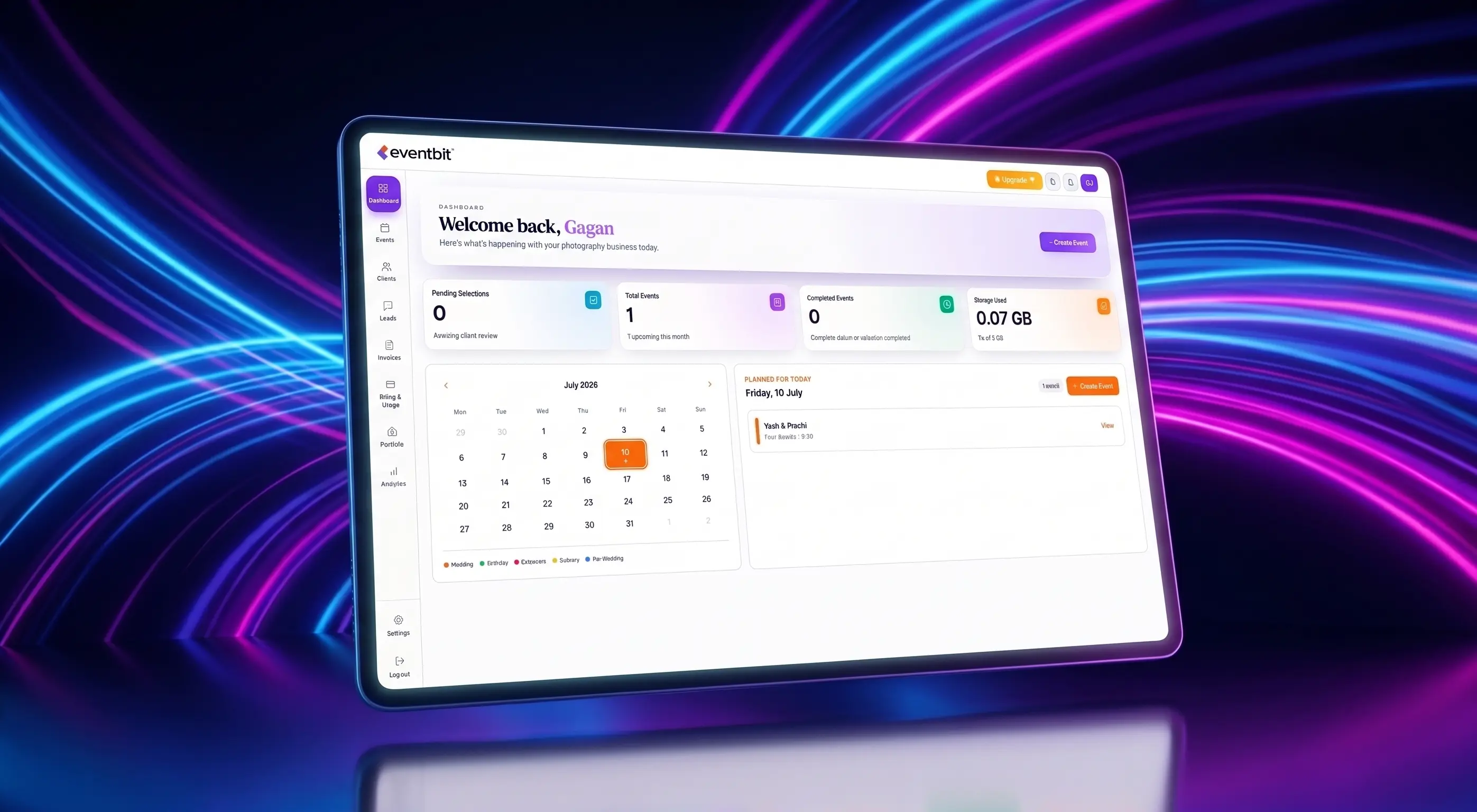
In Eventbit's GST invoicing, you can record a deposit and part-payments against the same client, send an invoice with an online payment link, and see what's still due.
Common invoicing mistakes
Most invoicing problems come from doing it by hand under deadline pressure.
- Reusing or skipping invoice numbers
- Leaving out the client's GSTIN for business clients
- Charging CGST and SGST on an inter-state job
- Losing track of advances, so the final invoice is wrong
- Sending invoices as editable documents that clients change
Keep invoices next to the work
The simplest habit is to raise the invoice in the same place you deliver the gallery. When the client, the event, the photos and the payments live together, you can see at a glance who has paid and whose gallery is ready.
That's how Eventbit is set up: client management, galleries and invoices sit in one workspace, and you can keep downloads switched off until the balance is paid.
Deven
Eventbit Team
Frequently asked questions
What is the GST rate on photography services in India?
Photography services are generally taxed at 18% GST. Confirm the rate and SAC code for your specific work with a chartered accountant.
Which SAC code should a photographer use?
Photography falls under SAC heading 9983. Event photography and videography is commonly listed as 998383. Confirm the exact code for your work with your CA.
Do I need GST registration as a freelance photographer?
Generally yes once your annual turnover crosses ₹20 lakh, or less in some special category states. You can also register voluntarily below that.
Can Eventbit create GST invoices?
Yes. Eventbit creates GST-ready invoices with deposits, part-payments and online payment links, next to your galleries and client records.
Run your whole wedding workflow in one place
AI face search, client selections, branded galleries and automated delivery — built for studios.
See pricing